
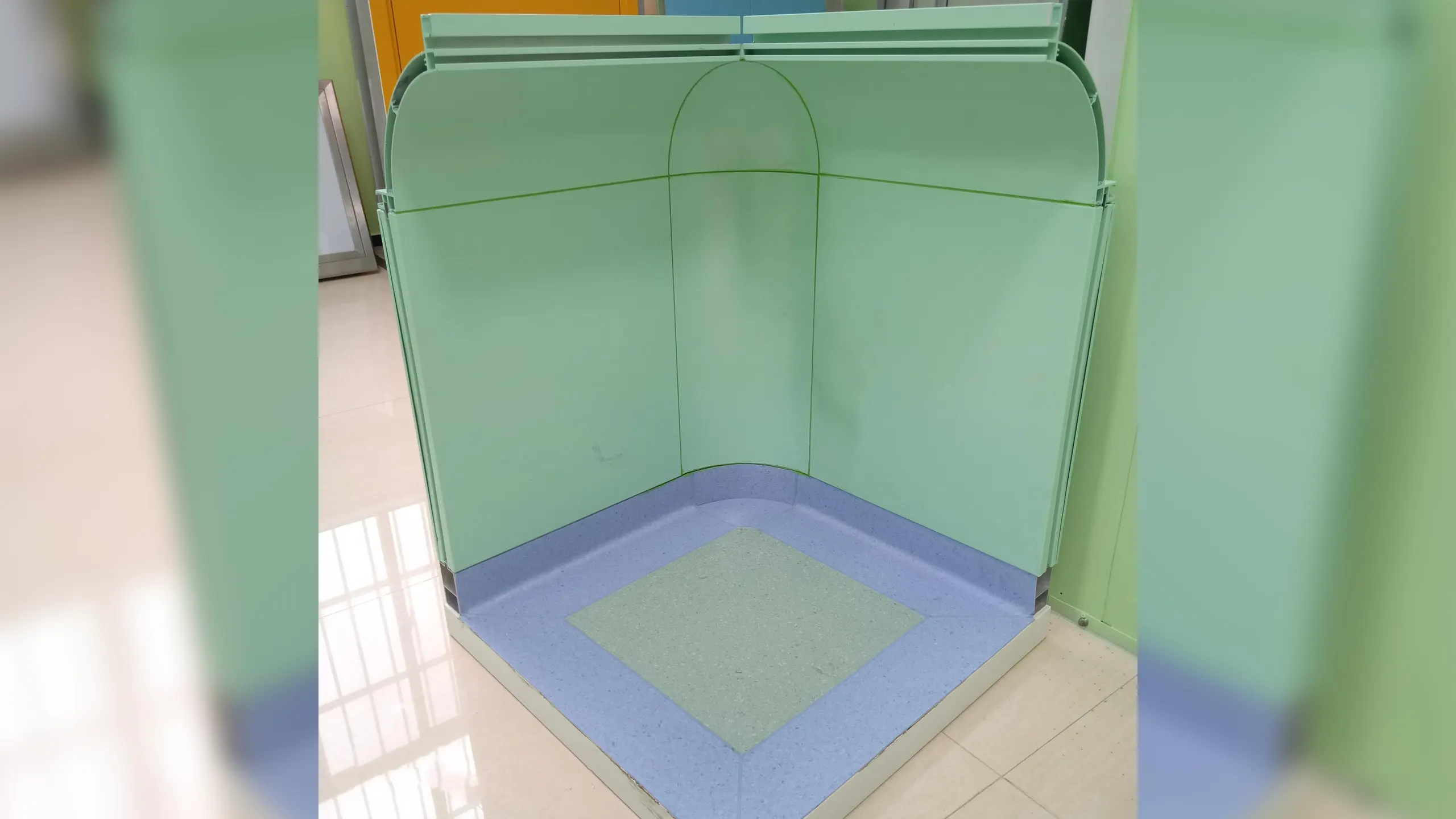
Keywordselectrolytic steel platecoated steel sheetoperating theatre wall panelcleanroom wall materialhygienic wall finish
What "electrolytic" means in practice
The coating is applied electrolytically, which deposits a thin, even layer that follows the sheet surface closely.
That evenness is what makes the material usable as a panel face: the coating does not thin at the edges or build up in patches, so the finished wall has a consistent surface across the whole panel rather than only in the middle.
It has to survive being formed
- The sheet is not fixed flat — it is cut, folded and formed into panels with folded edges and corners.
- A coating that cracks at a fold leaves an untreated edge on a wall that has to be cleaned.
- The electrolytic layer is chosen because it moves with the sheet under forming, which is the reason this material rather than a painted one is used for the visible face.
Promptmacro close-up of coated steel sheet surface showing even smooth finish, reflective light across the surface, material detail photography
ShotThe coating surface at close range, showing an even finish.
Product03.1 Electrolytic Steel Plates
Promptsheet metal folding machine forming coated steel into a wall panel with a folded edge, workshop machinery, industrial detail photography
ShotCoated sheet being folded into a panel edge.
Product03.1 Electrolytic Steel Plates
What to state when ordering
Three things: the thickness the panel needs for rigidity, the colour, and whether the sheet is supplied flat or already formed.
Larger panels and longer unsupported spans need a thicker sheet to hold a flat face. Supplying it already formed suits a project where the panel sizes are fixed; supplying it flat suits a fabricator who forms the panels themselves.
